Pages

Showing posts with label genre: historical fiction. Show all posts

Tuesday, June 23, 2015

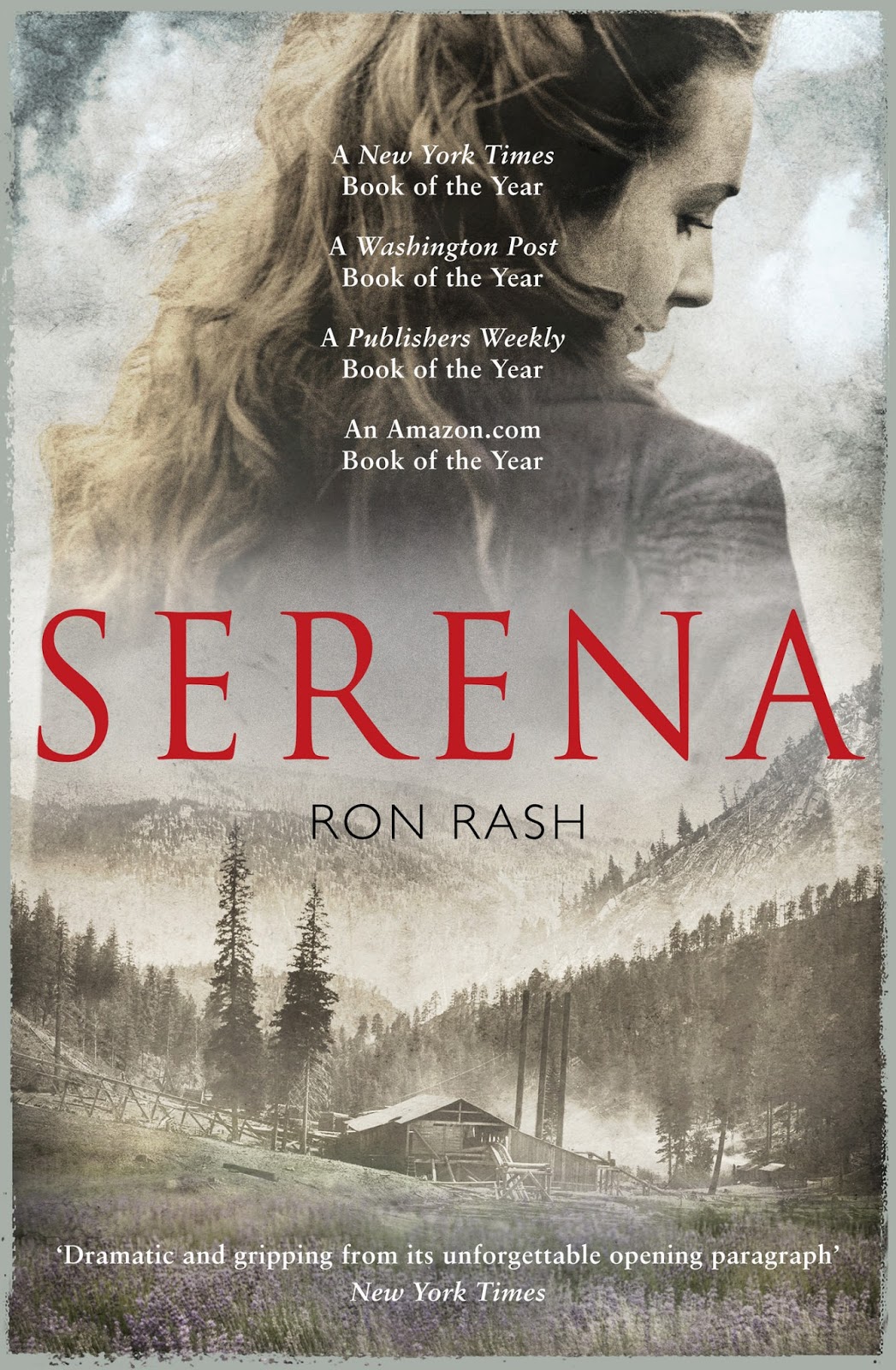
Serena - Ron Rash

I first heard about Serena via the movie with Jennifer Lawrence and Bradley Cooper. While I haven't yet gotten to see it--partly because it was apparently so poorly received that it skipped theaters entirely? Was it that bad--it did inspire me to pick up the original story that the movie was based on, by Ron Rash.


Now I don't know if this pair just really likes working together or what, but that aside, JLaw is a really odd casting choice in this for me. She always looks like she's kind of confused, or sad, or both, at any given time, and after getting to know Serena in this story I really expected her to look more coldly distantly beautiful. That said, I haven't seen her performance, so maybe she pulls it off just fine. Or maybe she doesn't, and that's why it tanked. I don't know.

Being the titular character, Serena is obviously who this story is really about. And I love her. She comes into my life at a time when I question our cultural insistence on women being likable and friendly and always accomodating, when I struggle with being authentic and standing up for my own rights. I've always been a kind of difficult person, and I pride myself on that, even when it creates difficulties in my life. Serena is raw in that way, but to a desperate extreme. She's an extremely hard, no-fucks-given I-get-mine kind of woman, and she will not tolerate disrespect of any kind, but especially that based on her gender. By all rights, you're not supposed to like her, but that's why I do. It's not often I get to see a real unlikeable female character that has such strength and drive, in a way that's more often attributed to male characters.

But naturally, Serena doesn't reach a balance in her life. Even as I admire her, I see how she will lead herself to disaster. Even given a drive for authenticity, I see the necessity of working within the confines of the culture one lives in. Serena and Pemberton run their logging camp with a hard hand, and as people pop up in their way, they kill or have them killed. They grow drunk on their own power and importance. Serena gets pregnant, miscarries--in part thanks to the buffoonery of the camp doctor--and tries to kill Pemberton's ex-lover Rachel in order to steal her child, but Rachel escapes to the West Coast with some money that Pemberton secretly has sent to her. Serena finds out, and ends up having Pemberton poisoned and left for dead as well. You don't cross Serena. The miscarriage is really like the turning point in her mental state: before it seemed she had a modicum of self restraint; after it was deaths galore. She trots off to Brazil to pursue her dream of chopping down all the Brazilian forests and becoming filthy, filthy rich.

Ultimately I think this story follows the traditional arc of the tragedy: everyone ends up sad and/or dead by the end of the book. The only people who got out in one piece is Rachel, and her illegitimate son by Pemberton. Serena gets the life she wants, sort of, but even that ends in murder.

Overall I found this story to be really enjoyable, in a dark, twisted emotional kind of way. Some of the characters maybe weren't as well-rounded as I would have liked (Rachel is very much the tormented angel, for example) and the use of loggers as a kind of chorus was an odd if interesting choice, but I enjoyed the general flow of the story.

Overall: 4 stars
Amazon: Serena

More reviews: Serena on Librarything (Average 3.71 stars)
Serena on Goodreads (Average 3.55 stars)

Wednesday, June 3, 2015

A Breath of Snow and Ashes - Diana Gabaldon

The second half of Outlander season 1 winds to a close--really, Starz did a pretty tidy job of containing an entire book in one season. They cut away exactly the right amount of material to make it work. The second season is already planned, based on Dragonfly in Amber, the second book.

Never have I loathed a character as much as Jack Randall. Can't wait till we see him again.

I'm way ahead, though: Breath of Snow and Ashes is the sixth book in the series that I'm just finishing up. It's been a long time since any of the main characters have seen Scotland. The focus is still primarily on Fraser's Ridge, much like the previous book. The number of residents of the ridge have steadily grown larger, especially after a number of new tenants from Scotland move in. Naturally, the new tenants are protestant, and see the Catholic Jamie as nothing short of the devil, but a protestant by the name of Tom Christie and Jamie's son-in-law Roger help bridge the gap as much as possible. Galbadon continues to emphasize the danger inherent in this time period, what with the war rapidly approaching and roaming bands of men who attack Claire and Marsali when they're out alone. Claire is kidnapped, beaten and raped--at least, until Jamie (et al) comes to save her.

There's an awful lot of rape in these books, I have to say. On the one hand, it's plausible that there really would be this constant threat to women in this time, what with being pretty much defenseless and property and all. But on the other hand, it seems we can't go more than ten chapters without somebody being at least threatened with rape. It's starting to feel like a repetitive and slightly cheap way to drive up the tension. At least it's equal-opportunity rape (what with Jamie and Randall), but still.

So, partly because Claire used her reputation as a witch/healer to fend off the men of this dangerous band, and partly because of her actual healing skill and refusal to conform to many standards of the time (no cap please!) the residents of the ridge begin to regard her as a devil woman. When Marsali's next child is born a dwarf tensions just run higher, because clearly, that's the devil's work right there. The McGillivray's start to shun Claire when she informs them that their son Manfred has syphilis (the pox), and they shame her for slander. Then Malva Christie--who Claire regarded as her protege--names Jamie the father of her unborn child and is later found murdered in Claire's arms, after Claire attempted to cut her child from her dead body (obviously she didn't murder her, but that's not how most of their people see it).

Basically, bad luck and modern decisions keep getting Claire in a world of hurt, and Jamie has to keep hunting her down to save her. When we're not saving Claire, we're saving Brianna, kidnapped by Stephen Bonnet. Again, I feel that I can possibly chalk this up to the time period, but after six books it gets a little old with all the your-princess-is-in-another-castle and here-comes-the-rape-train. While I still like the series (and $5/book for kindle makes it easy to keep going) it's not quite got that same hook into my heart that the first book did.

Writing-wise, we're seeing a lot of the meandering plotline that we saw in the previous books. I still think this is an interesting tactic, where you literally cannot sum up the plot in a sentence. It's more this-happens-then-this-which-leads-to-this than it is one central question. At the Writers in Paradise conference we talked about the concept of a central narrative question, and how it strengthens writing. The pieces that did the best in our workshop were the pieces that had a very strong question, and Mr. Watson emphasized that the strongest is phrased as: Will Character1 Blank Character2?

Now, a short story will probably only have one question, or one large question and a few small ones. But a novel might have one really big question (for example re: Outlander book 1, will Claire stay with Jamie?), it's got to have a metric ton of smaller questions of varying sizes. This series interests me because it doesn't have one central question for many of these books, but a series of plotlines weaving in and around each other. We might say that the main unifying plotline in this book is the degeneration of the Fraser's standing among the families of the ridge as war approaches, but there's many smaller plotlines woven together around it that contribute to their downfall. So it's difficult to summarize this book accurately and I like that. It indicates a level of complexity that's very intriguing.

So I guess it shows that, done right, you can actually avoid that central question, but it's still something to keep in mind for us newer writers. Like the rules of grammar and punctuation, maybe you should know how to use them properly before you start disregarding them.

“Couldn’t be simpler,” I assured him. “I do a process called fecal sedimentation to concentrate the stool, then look for the eggs under the microscope.”
He nodded, plainly not following. I smiled kindly at him.
 “All you have to do, Bobby, is shit.”
His face was a study in doubt and apprehension.
“If it’s all the same to you, mum,” he said, “I think I’ll keep the worms.”

Real danger had its own taste, vivid as lemon juice, by contrast with the weak lemonade of imagination.

“I’m so sorry, Mrs. Fraser,” she whispered, tears trembling becomingly on her lashes. “He— we— we didna mean to hurt ye.”
I watched with interest from somewhere outside my body, as my arm lifted and drew back, and felt a sense of vague approval as my hand struck her cheek with enough force that she stumbled backward, tripped over a stool, and fell, her petticoats tumbled up to her waist in a froth of linen, wool- stockinged legs sticking absurdly up in the air.
“Can’t say the same, I’m afraid.” I hadn’t even thought of saying anything, and was surprised to feel the words in my mouth, cool and round as river stones.
Overall: 4 stars

More reviews: A Breath of Snow and Ashes on Librarything (Average 4.26 stars)


Tuesday, May 5, 2015

The Lighthouse Road - Peter Geye

So like, I kind of love historical fiction. Maybe not quite as much as I love a good, weird, speculative fiction, but still a whole damn lot. I'll read the story of Henry Tudor and Anne Boleyn in a million different iterations from a million different authors (and I have), no problem. But I really enjoy exploring the different parts of the world in different eras, too. It's not really so different from science fiction or fantasy, when you think about it: there are some similarities between the world of the story and our own, but there are a lot of differences too, and well-written historical fiction allows the reader to escape into that world just as much as a good fantasy novel does.

The Lighthouse Road (not to be confused with 16 Lighthouse Road, a fluffy Macomber book that Google seems to think I mean) is set in Minnesota in the late 19th and early 20th century, on the shores of Lake Superior. Peter Geye sets up a dual storyline of Thea, a young Norwegian woman immigrating to America and going to work at a logging camp in the tiny town of Gunflint; and her son Odd, raised by the village after her death, and his affair with Rebekah, a much older woman who helped deliver him. Their stories parallel in a lot of ways, centering on dangerous relationships and trying to find one's own way and one's happiness in a harsh world.

I actually read this book for a class, but of the books that were assigned, this really was my favorite. The other books we read were poetry, and Geye's writing, by contrast, is very simple and straightforward. I found it really interesting how he could use some very physical, relatively simple sentences, and use them to create poetry in images. There's a lot of images from this book that really stick with me: Odd going out onto the lake to pick up whiskey from smugglers; Odd finding the postcards of Rebekah for the first time; Rebekah falling into her deep moods when their baby is born in their tenement in Duluth. I guess I like the contrast of using straight prose to create poetic images without getting flowery.

I guess there's just not a ton for me to say on this one: it's well-written and I enjoyed it, but there's not enough in it to really make me wax poetic about its virtues. Nothing to really nitpick either. Definitely a decent read, I just don't know if I'd go out of my way to find it.

No quotes today, because I already gave the book to my mom. Oops!

Overall: 4 stars
More reviews: The Lighthouse Road on Librarything (Average 4.09 stars)
The Lighthouse Road on Goodreads (Average 3.60 stars)


Wednesday, April 15, 2015

The Fiery Cross - Diana Galbadon

Well, the second half of Outlander season one has premiered. I've only been waiting for it for ages, after all. I knew there was going to be some controversy this season, of course, but it's in this second half of the season/first book that I feel the plot really stops establishing itself and starts running forward. Claire, girl, you gonna be in so much trouble.

Claire, just because someone is nice to you, doesn't mean they're a good person.

So while I was waiting for the resumption of my pretty-people-in-pretty-clothes guilty pleasure, I've been working my way through the rest of the series. Previously I've covered Drums of Autumn, Book 4; so here we continue with The Fiery Cross.

We pick up at the Scottish Gathering, where Brianna and Roger are to be married at the same time as Jamie's aunt Jocasta and Duncan Innes. Naturally, complications ensue. The priest is arrested, Jamie is charged with raising a militia, a slave at River Run takes a dose of laudanum and later crushed glass originally meant for Jocasta's intended, Jamie is faced with having to choose between being loyal to Governor Tryon (by whose hand Fraser's Ridge was granted) and knowing that the American Revolution is just around the corner and that he is already on the losing side. Somehow they must get through the Revolution with their land and families intact, and he struggles with how to prepare the Ridge for that. Stephen Bonnet reappears and so does Young Ian.

If it sounds like there is no overarcing plot, it's because there isn't. And I'm really not complaining when I say that. In fiction writing I feel like I'm often taught that the plot needs to follow a logical progression of "Protagonist makes a choice, therefore this happens, therefore this happens, therefore this happens". But a lot of what's happening in this book isn't necessarily a progression at all, and many pieces are unrelated to each other but relate back to things that happened in earlier books, and things that are happening in the time period that it takes place. This is not a plot that you can summarize neatly, in the way of "Frodo takes the magic ring to Mount Doom and destroys it". It much more resembles how a real life story might take place. I find this to be a really interesting tactic, and I like it enough that I want to file it away for my own future use. 

It's really interesting when we're playing with time travel here as well. Any historical fiction taking place in the Americas just before the Revolutionary War, we as the reader know what's coming though the characters don't. In this case, the character's do know what's on the horizon--at least some of them do. It adds another dimension to their troubles of the time, having to prepare without letting on that they know anything at all. In addition, we--AND the characters--know the date that Claire and Jamie are supposed to die, but what we don't know is whether or not that can be changed. There's a level of uncertainty to it all that makes the time travel unsettling in a very effective way.

They must survive for quite a while, at least: the book leaves off in 1772 and there's still three more books to go!

Possibly the most heartbreaking moment in this book--and Galbadon excels at the heartbreaking--is when Roger is hanged. While he lives, the damage to his throat makes it questionable whether he will ever sing again. For a man so devoted to music to have lost it in this way, because of one big fat jerk who just happens to be his ancestor... yeah, that part will stick with me.

“Sometimes,' he whispered at last, 'sometimes, I dream I am singing, and I wake from it with my throat aching.'
He couldn't see her face, or the tears that prickled at the corners of her eyes.
'What do you sing?' she whispered back. She heard the shush of the linen pillow as he shook his head.
'No song I've ever heard, or know,' he said softly. 'But I know I'm singing it for you.”
“Blessed are those who eat greens, for they shall keep their teeth. Blessed are those who wash their hands after wiping their arses, for they shall not sicken. Blessed are those who boil water, for they shall be called saviors of mankind.”
Overall: 5 stars

More reviews: The Fiery Cross on Librarything (Average 4.12 stars)
The Fiery Cross on Goodreads (Average 4.25 stars)


Sunday, March 1, 2015

The White Princess - Philippa Gregory

I have a bit of an obsession with British history, specifically anywhere from the War of the Roses up through the Victorian era. I may have spent a good hour at work one night painstakingly tracing the passage of the crown through British royals from 1327 to the modern day.

I bet you thought I was kidding. I don't joke about history.
(I do joke about history.)
I notice now that I should have changed the display of the Tudor children so they don't all appear to be descended from each other. I'm only human.

I never really get tired of the stories, even when I know them intimately. As such I read a lot of authors who cover the same eras: Alison Weir, Carolly Erickson, Robin Maxwell, and the quintessential royalty-writer herself, Philippa Gregory. With, at my best count, 15 novels specifically featuring British royals, she was the first historical fiction writer that I really got into. (Though, interestingly, my favorite series of hers is actually Georgian and doesn't feature royalty at all--Wideacre) It's pretty much required that I need to pick up each of her new books as she works her way through the Cousin's War.

This is another of my recent reads that has a television adaptation to go along with it. BBC and Starz released the miniseries The White Queen in 2013, based on Gregory's previous books. Now Starz is developing a second miniseries as a sequel, based on this book. I haven't yet seen the first one, but given that I now have both Outlander and these adaptations to be watching, I might have to get Starz on my cable service.

Freya Mavor played Elizabeth of York in the first miniseries, so I wonder if we'll see her return for the titular role of the White Princess. The story covers so much of Elizabeth's life that it may be very difficult to use such a young actor (Mavor is 21).


Summary:
In this, the fifth book of the Cousin's War series, we feature Elizabeth of York. The daughter of the old king Edward IV and Elizabeth Woodville, featured in the previous book The White Queen, Elizabeth of York spent some time as the paramour of her uncle, Richard III, featured in the previous book The Kingmaker's Daughter. Richard III has been overthrown by Henry Tudor, soon to be known as Henry VII, and Elizabeth is to marry him. The White Princess tells the story of their marriage, at turns cold and loving and full of fear and cold again, and that of the mysterious Boy who may or may not be Elizabeth's brother Richard, one of the two boys who disappeared from the Tower.


Elizabeth of York and Henry VII. 

As a reader:
This story is about a mystery at its heart, and we never really get a payoff. Is the Boy Elizabeth's long-lost brother? Or is he really Perkin Warbeck, one of the many names put upon him? Gregory seems to be implying that he is the true Richard of York, but it is never explicitly stated. In this way it seems that Gregory has started the book at a certain tension level, and then just left us there, without amping up or resolving any of it. It's very unsatisfying in this way and I have to wonder if at 60 Gregory is just getting tired of this work. I feel as if I could summarize this entire story as follows:

Henry: "What do you know?"
Elizabeth: "Nothing."
Henry: "But what do you know?? You're a York!"
Elizabeth: "Nothing."

BORING. If the characters never know anything, then the reader looking through their point of view never knows anything either, and then what, exactly, is the point of the story? This story is missing the mysticism and the strong women of Melusina in previous books. It just feels fairly flat.

About the only thing that really grabbed me in this book was the relationship between Elizabeth and Henry. Elizabeth herself is a fairly empty character, but I think that reflects more on what she had to be in context than on Gregory's writing. She was beset with suspicions from her husband's family, and essentially had to withdraw from the world to stay clear of any ill associations. Henry, on the other hand, is a vibrant character, full of fear and uncertainty. Their marriage begins on such terrible ground--Henry insists he must see if Elizabeth can get pregnant before he commits himself to her, and so, premarital rape--but somehow, over time, they come to feel a kind of fondness for each other. For a time, they are happy. But the state of their relationship mirrors the state of the kingdom, and when Henry is on rocky ground, so too are they.

As a writer:
If Gregory's tired of writing, her editor must be tired of proofreading. I'm the type of reader who stumbles over errors like a loose brick: I'm clumsy and I can't help it. I found so many minor errors in this book that, individually are nothing, but they interrupt my flow and it looks unprofessional.

"None of her ladies is[sic] here, her musicians are absent..."

"As the wife of the king, I can kneel to him publicly and ask for clemency for a criminal. Maggie will come forwards[sic] and take off my hood..."

"None of the people of the west is[sic] for Tudor, they are all looking for the prince over the water."

Touching back on the tension, this book really emphasizes for me the importance of the plot structure. I realize that it can be more difficult to use this structure when working with an existing story in history, because you are in some ways limited to what actually happened. However, this is still, at its core, fiction. We don't know enough about these historical figures to say exactly how they would have acted or behaved, and so enough leeway is there to, I think, stay with the basic structure of plot.

The plot structure of this book would be less like a mountain and more like a sound wave. No climax, no resolution, just a series of little ups and down.

It's not all bad, though. It's still Philippa Gregory, and girl knows how to do words.

"Everywhere Henry goes, people fall silent so that no whisper reaches his ears; but before and behind him there is a patter of sound like a warning drizzle before a storm of rain."
Overall: 3 stars.

More reviews: The White Princess on Librarything (Average 3.62 stars)


Sunday, February 15, 2015

Drums of Autumn - Diana Galbadon

I was introduced to the Outlander series late, first via the Showtime adaptation. After devouring the first half-season, I thought I should fill the void waiting for the next episode release with the books themselves. This is a really odd order for me, to watch the adaptation first and then go back and read the book, but for once, I'm really glad I did. Though some changes have been made in the adaptation process, I liked being able to picture the actors in their book roles. Caitrona Balfe and Sam Heughan are both incredibly good-looking and have great chemistry for their roles, and what more can I ask for in romantic historical fiction leads? I'm sure there was some upset among fans of the books with the casting--I mean, the first book was published in 1991 so there's been quite a bit of time to build a fan base--but I'm satisfied, so fig to that.

Not entirely sure if 35-year-old Sam is supposed to still be 22-year-old Jamie as he is in the books..

Summary:
Drums of Autumn is the fourth book in the Outlander series. In previous books, Claire has traveled through the stones for the third time, and have left Scotland behind to recover Jamie's kidnapped nephew Ian. They've traveled into the West Indies, naturally encountering many obstacles along the way, including a drunk "chinaman" (jesus even though that is period that makes my skin crawl), magic slaves, and the reappearance of Geilis Duncan. Book 4 opens in South Carolina, where throughout the course of the novel the Frasers establish their new home on what they dub Fraser's Ridge, hoping to finally have a permanent settlement. In the future, their daughter Brianna plots to travel back through the stones as well to finally meet her biological father and see her mother once more, but she is followed by her love Roger Wakefield, who is a descendent of Geilis Duncan and Jamie's uncle Dougal Mackenzie. Naturally, misunderstandings, danger, and hostilities with the military, pirates, and local tribes ensue.

Period costume porn. WHY ARE YOU TWO SO PRETTY.

As a reader:
There's a good reason that these books and the Starz adaptation are gaining in popularity. Diana Galbadon is adamant that she did not write these as romance, but the romance crowd is eating them up--and those of us who don't go in for your typical romance pulp find plenty to like here too. I care about these characters, enough to fume when they're doing something stupid and wilt when they're misunderstanding each other. At times this actually works against Galbadon, however--in the heightened sense of drama accompanying Roger's sojourn with the Mohawks, I found myself skimming parts to find out whether he was alive or dead. I wanted to know the next plot point so badly that I tended to skip any description and characterization in between. It's got the same quality that makes romance readers keep coming back: we're invested, we're addicted, and we need to know if they get together in the end.

As a writer:
I'm pretty dismissive of the romance genre (though more posts on that to come), not because it is a primarily female genre but because often the writing is just so. goddamn. bad. Maybe that's why Galbadon is so adamant that she's not writing romance: romance isn't regarded as literary. Whether or not that term can be applied to Outlander is debatable, but it is definitely above the romance genre in terms of technical writing skill. I use the term 'highly readable' as a compliment, in the sense that I don't stop and stumble over any of Galbadon's sentence structure, and that nothing jumps out as being a glaringly irritating idiosyncrasy such as I find in, let's say, Sarah Maclean.
Then there's the subgenre of historical romance. While I'm not incredibly well-read in the romance genre, the few that I have sampled that have fallen under the historical label have, let's say, sacrificed the historical-ness for the romance-ness, which completely ruins the entire book. Galbadon, on the other hand, has done a fantastic job constructing a historical setting that is believable. The difference? Research. Mountains and mountains of research. It's clear she's done it, and it shows. That's not to say she's perfect--there's been some corrections regarding her use of Gaelic and whatnot, but nothing so glaring that I think your average historical fiction fan would notice. Someone more immersed in Highland lore may feel differently, of course, which is always a hazard when an author tries to write of a culture that isn't their own. (Diana Galbadon is American, and, presumably, did not grow up in the 18th century.)
Galbadon makes good use of aphorisms in her work, almost tailor-made to be quoted in social media profiles and sighed over.

“forgiveness is not a single act, but a matter of constant practice”

“Your face is my heart Sassenach, and the love of you is my soul” 

“An Englishman thinks a hundred miles is a long way; an American thinks a hundred years is a long time” 

“If ye have to ask yourself if you’re in love, laddie—then ye aren’t,”

Lastly, one description that I really enjoyed:
"...she jumped,giggled in a voice like honey poured out of a jug..."

Overall: 4 stars.