Pages

Wednesday, April 22, 2015

The Fire Sermon - Francesca Haig

The trilogy sure is big right now. It seems like every new YA book coming out is automatically planned to be part of a trilogy right off the bat: and I get it, really. I get it from a marketing perspective. Publishers want to ride the YA popularity wave (especially dystopian YA) by selling three books instead of one to a hungry market and hopefully in the process option the rights off for future movies as well. And if those can be expanded into multiple movies, well, all the better. So yeah, I get it. But that doesn't mean it's good.

Artistically, it creates some problems. Some stories just don't work that well as trilogies, suffering from pacing issues, tangents, or artificial-feeling subplots. The Fire Sermon is one of these that I feel would have been better told in a much tighter manner, as a more efficient long single novel than three scanty short ones.

Haig's starting with a great concept here: after some kind of worldwide disaster in which the world was swallowed in fire (I'm guessing nuclear, but obviously the narrator doesn't know exactly what happened and neither do we), every person is born into a pair of twins. The Alpha twin, physically perfect, and the Omega twin, with some sort of deformity. The Omega twins are removed from the Alpha population, sometimes early when the difference is obvious, and sometimes late when it is subtle. The main character, Cass, is the Omega twin, but she has no deformity. She is a Seer. She dreams things that will happen, or sometimes sees things far away, or sometimes knows where things are--it's all very vague and mystical. She's Special, though, with a capital S. She's Different from all the others.

But it's important to separate concept from plot: a great concept is wonderful. But it only gets you 25% of the way there. You still have to use that concept to tell a good story. To illustrate the specific issue with this book, I direct you to The Hero's Journey:

This basic pattern, also called the monomyth, was created by Joseph Campbell, best known as a mythologist. He argues that many myths (and subsequently, many stories) share the same basic structure, though they differ in the finer details. Many of our most famous stories can be lined up with this structure, including Star Wars and the Matrix.

Now the applicability of the Hero's Journey to literature can be contentious. I think some would argue that it doesn't have to apply to a piece for it to be considered a good story, and I agree. However, I think it is a useful tool for understanding when something doesn't work quite as well as it could, and how to improve it.

In specifics: The narrator of The Fire Sermon spends about 75% of the book refusing the call.

Literally: line after line of characters asking her to use her abilities to help the Omegas, and line after line of her absolutely refusing. Yes, it's a little more nuanced than that. She doesn't see their situation as an us-vs-them like most people do (remember, she's Different!). She sees the twins as two parts of a whole, and not something she wants to fight against. Yet again, I get it. But narratively, spending three quarters of a book stuck at the same stage is not good for a story. As a reader, I got bored. I got annoyed. I started to roll my eyes at the narrator. I wanted the story to progress, and instead, Cass just keeps running. Early in the story she's placed in a kind of prison: she escapes, and she runs. They get to an island Omega sanctuary: but it gets attacked, and she runs. She's just so very passive that it gets a little grating.

A lot of that may be my personal opinion, obviously. I prefer characters that are active, that make decisions, that push the narrative forward by their choices, not just by what happens to them. Other people may like this kind of narrator. To each their own, really, I won't deny that. It just doesn't do anything for me.

Partly this probably has to do with the fact that I'm not really the target audience for this book, either. YA is really aiming at teenagers, and so it's very probable that they want different things out of a story than I do. One part of the book that I was ambivalent about may play right into something that's popular for the YA audience: it's all very internal. Things do happen externally, but a huge amount of time we spend in Cass's head, with her thoughts and her memories and her feelings, to the point where some of the things that happen externally seem almost incidental. It's been a while since I've been a teen, but from what I remember, in general we were all pretty internal in that way: what was going on inside of us was just so incredibly important, because hey, it was a big confusing time we were trying to make sense of. So while I was unsure about the effect, I have the impression that in particular would work well for a YA audience.

One thing I did find really interesting was the age of the narrator. Typical YA books have the protagonist around the same age as their audience: sixteen, maybe seventeen, something like that. But Cass is nineteen when she goes into prison, and in her early twenties when she escapes. Even if we're sticking with a lot of YA tropes in other parts of the books, I think it's refreshing to see something different now and then.

Lastly, I'm a little tired of amnesia as a plot device. It rarely works in real life the way it works in books and movies: where a person can function perfectly normal, but simply doesn't remember personal information like their name or their family or memories of their childhood. It's just overused at this point, and I'd like to see some new directions taken, personally.

Overall there's nothing particularly abhorrent about this book. It's fine, the writing is well done, the plot does move, albeit sluggishly, and it feels artificially stretched out to fill three books. It'll probably do pretty decently in the YA market, though I'm just not interested enough to pick up the second book.

What does my opinion matter, though? Haig has already optioned the rights to the film, so she's taking it to the bank. Some of us writers should be so lucky!

Overall: 3 stars
Amazon: The Fire Sermon

More reviews: The Fire Sermon on Librarything (Average 3.65 stars)
The Fire Sermon on Goodreads (Average 3.68 stars)

AWESOME cover.

Sunday, April 19, 2015

Borders of Infinity - Lois McMaster Bujold

There's something really comforting about series from good authors. I like knowing that I can keep going back for more Vorkosigan from my hero Loid McMaster Bujold. And given how great the narrator is, I just keep picking them up in audiobook form every time I get a credit from Audible. Good for housework, knitting, driving, walking, boring times at work, any time I want to shut out anyone obnoxious; I'm hard pressed to find a time when an audiobook ISN'T the right choice. So I return to Miles Vorkosigan with my metaphorical blanket and hot tea, curled up in front of a window on a rainy day.

Borders of Infinity is actually a three novella collection, including the novella of the same name and two others, The Mountains of Mourning and Labyrinth. Each have entirely separate storylines, tied together by a rather thin thread of Miles being questioned about each of these incidents during recovery from one of his many surgeries. Really, we could have done without the 'present' storyline at all. Each novella stands well enough on its own, but I think it was probably written up just for the release of these three together. There are other collections the novellas can be found in, so I suppose they had to tie these together in some way to make them stand together.

The Mountains of Mourning is actually my favorite of the three, because we're seeing a side of Barrayar that is normally quite hidden. A woman appears at Miles' home, asking to appeal to Count Vorkosigan for justice for her murdered infant, a baby girl who had "the cat's mouth", or a cleft lip/palate. Many Barrayarans have been fighting the mutant stigma for years, but in this backcountry it remains strong. Miles is dispatched by his father to investigate who smothered the child and decide for himself what to do about it. Especially nice was how Miles found a way to use the tragedy to better the whole area, by sending the child's mother to a school to learn how to become a teacher, so that she can come back and improve the lives of all the local children. Through education do people stop murdering their babies, one hopes.

I find it really interesting to explore characters that Miles wouldn't normally interact much with: his own people. He's spent so much time in space with the mercenaries or in the Barrayaran military tht we forget he has familial duties regarding the people who are technically under the care of his family. It was also nice to see 'country' people portrayed varyingly, rather than a monolith of stupid and intolerant. Sure, there were a few stupid and intolerant characters in the mountains, but there's a few on the ships, and in the Vor, and the goverment, too. I just like that those traits define those characters, and not their people as a whole.

Labyrinth was also interesting, for here we see the introduction of Taura. I remember Jackson's Whole from Ethan of Athos, mostly as a seedy planet with a penchant for immortality via transplanting brains into homegrown clones. The Houses that populate Jackson's Whole all seem to be very interested in genetics, and trade both in interesting genomes and creatures (or people) created using them. Miles and the Dendarii are sent to retrieve a particular scientist from House Bharaputra, only their plans go awry when Dr. Canaba places the genomes he was going to take within a living creature that is subsequently sold to Baron Ryoval. They have to stage a mission to infiltrate Ryoval's labs and retrieve the sample and kill the creature. Only.. it turns out the 'creature' is really an altered sixteen-year-old girl, cold, starved, hurt and scared.The retrieval mission turns into a rescue mission with some laboratory vandalism thrown in for good measure.

Taura is a fascinating character, and so far one of my favorites. She was part of a batch of embryos genetically altered to be super soldiers, possibly by using animal genes. By consequence Taura is very large, very strong, and very fast: her metabolism runs at a much faster rate than regular humans, and she is the only one of her cohort to have survived this long. Her face is almost leonine to Miles, and she has functional fangs and claws. She's been treated as an animal or experiment for so long that it's baffling to her when Miles treats her like a human. And treat her he does. She asks him to prove her humanity by sleeping with her. For such a self-proclaimed ugly, Miles sure gets a lot of action from a lot of hot ladies. (I had an ick moment here, but then realized this story was taking place when Miles was only 23--so the age difference isn't quite as stark as I initially thought.)

Lastly is Borders of Infinity itself. In this novella Miles as Captain Naismith infiltrates a Cetagandan prisoner-of-war camp to rescue a captured Colonel who was supposed to stage a Marilacan resistance against the Cetagandans. Only the Colonel is beyond Miles' help, and he still must figure out a way to rally the prisoners and escape from the dome the Cetagandans have encased him in. A good story that showcases Miles' ability to read and influence people, which is really his greatest asset--how else could a teenager bluff his way into commanding an entire mercenary crew? Overall I just didn't find it quite as interesting as the other two, but it's certainly a fine story on its own. Miles spends a lot of time naked. He practically creates a religion. He gets beat up by some women for a while and falls a little bit for a tragic redhead.

So I'll leave you with classic Bujold Vorkosigan quips.
“Bleeding ulcers run in my family, we give them to each other.” 
“If you can't be seven feet tall, be seven feet smart.”
Overall: 5 stars
 
More reviews: Borders of Infinity (Collection) on Librarything (Average 4.14 stars)
Labyrinth on Goodreads (Average 4.16 stars)


Wednesday, April 15, 2015

The Fiery Cross - Diana Galbadon

Well, the second half of Outlander season one has premiered. I've only been waiting for it for ages, after all. I knew there was going to be some controversy this season, of course, but it's in this second half of the season/first book that I feel the plot really stops establishing itself and starts running forward. Claire, girl, you gonna be in so much trouble.

Claire, just because someone is nice to you, doesn't mean they're a good person.

So while I was waiting for the resumption of my pretty-people-in-pretty-clothes guilty pleasure, I've been working my way through the rest of the series. Previously I've covered Drums of Autumn, Book 4; so here we continue with The Fiery Cross.

We pick up at the Scottish Gathering, where Brianna and Roger are to be married at the same time as Jamie's aunt Jocasta and Duncan Innes. Naturally, complications ensue. The priest is arrested, Jamie is charged with raising a militia, a slave at River Run takes a dose of laudanum and later crushed glass originally meant for Jocasta's intended, Jamie is faced with having to choose between being loyal to Governor Tryon (by whose hand Fraser's Ridge was granted) and knowing that the American Revolution is just around the corner and that he is already on the losing side. Somehow they must get through the Revolution with their land and families intact, and he struggles with how to prepare the Ridge for that. Stephen Bonnet reappears and so does Young Ian.

If it sounds like there is no overarcing plot, it's because there isn't. And I'm really not complaining when I say that. In fiction writing I feel like I'm often taught that the plot needs to follow a logical progression of "Protagonist makes a choice, therefore this happens, therefore this happens, therefore this happens". But a lot of what's happening in this book isn't necessarily a progression at all, and many pieces are unrelated to each other but relate back to things that happened in earlier books, and things that are happening in the time period that it takes place. This is not a plot that you can summarize neatly, in the way of "Frodo takes the magic ring to Mount Doom and destroys it". It much more resembles how a real life story might take place. I find this to be a really interesting tactic, and I like it enough that I want to file it away for my own future use. 

It's really interesting when we're playing with time travel here as well. Any historical fiction taking place in the Americas just before the Revolutionary War, we as the reader know what's coming though the characters don't. In this case, the character's do know what's on the horizon--at least some of them do. It adds another dimension to their troubles of the time, having to prepare without letting on that they know anything at all. In addition, we--AND the characters--know the date that Claire and Jamie are supposed to die, but what we don't know is whether or not that can be changed. There's a level of uncertainty to it all that makes the time travel unsettling in a very effective way.

They must survive for quite a while, at least: the book leaves off in 1772 and there's still three more books to go!

Possibly the most heartbreaking moment in this book--and Galbadon excels at the heartbreaking--is when Roger is hanged. While he lives, the damage to his throat makes it questionable whether he will ever sing again. For a man so devoted to music to have lost it in this way, because of one big fat jerk who just happens to be his ancestor... yeah, that part will stick with me.

“Sometimes,' he whispered at last, 'sometimes, I dream I am singing, and I wake from it with my throat aching.'
He couldn't see her face, or the tears that prickled at the corners of her eyes.
'What do you sing?' she whispered back. She heard the shush of the linen pillow as he shook his head.
'No song I've ever heard, or know,' he said softly. 'But I know I'm singing it for you.”
“Blessed are those who eat greens, for they shall keep their teeth. Blessed are those who wash their hands after wiping their arses, for they shall not sicken. Blessed are those who boil water, for they shall be called saviors of mankind.”
Overall: 5 stars

More reviews: The Fiery Cross on Librarything (Average 4.12 stars)
The Fiery Cross on Goodreads (Average 4.25 stars)


Tuesday, April 7, 2015

Martin Chuzzlewit - Charles Dickens

At first, it seems completely ridiculous for me to be 'reviewing' a book originally published in 1843. But as I'm trying to do a little less 'review' and a little more 'analysis', I think it's important to take a look at older novels as well as what's current, to see what worked for the time, what still works today, and what falls on it's face after a hundred and fifty years. Some parts of writing are timeless--we sure would all like to think our own work will be timeless, but more often we're dated not only by the era the story takes place in but also by the conventions used.

For example, one of my intial complaints about Martin Chuzzlewit is how utterly meandering the plot is. There are two Martin Chuzzlewits in this book, Sr. and his grandson Jr. Martin Chuzzlewit Sr. has his companion Mary, a young orphan he has raised with the knowledge that she gets nothing of his fortune when he dies, so her wellbeing depends on his health. Martin Chuzzlewit Jr. has proposed to Mary and has been accepted, but they are forced apart by Sr's ire at the match. You would think this is what the story would revolve around, but we're not done yet. There's also Mr. Pecksniff, a self-decieving rogue, and his two daughters Charity and Mercy, and his apprentice Tom Pinch, who sees Pecksniff as nothing short of an angel, though the rest of the world begs to differ. Charity is romanced by Jonas Chuzzlewit, son of Anthony Chuzzlewit, brother of Martin Chuzzlewit Sr, but is jilted when he instead proposes to Mercy, who accepts him and proceeds to become very miserable in her choice. Now, two storylines would be fine, but it splits yet again to feature random characters that make little impression on the memory, and whose chapters do nothing but bore me. I'm not even sure who the main character(s) are supposed to be anymore.

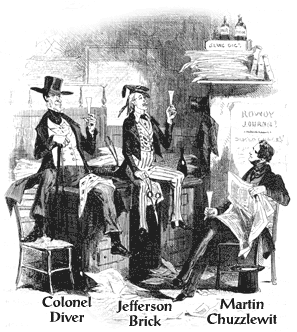
The illustrations are pretty hilarious though.
"I say, look at these bitch-ass Americans. Bunch of loony todgers." - Martin
 

Now, all of that makes sense when I find out that this book was originally serialized, with a few chapters released at a time. Discovering that, for example, the first few chapters (featuring primarily Pecksniff) received a lukewarm reception and Dickens completely upended his own plot to send Martin Chuzzlewit Jr. to America, affording him an opportunity to satirize a whole different country, suddenly makes the meandering plot make sense. It seems like Dickens doesn't know where he's going because he actually doesn't know where he's going. It's frustrating, because today this is a big No No of the literary world. Even if you're writing to discover the story, you damn well better have found it before you publish.

And no, paragraph upon paragraph of metaphor/aphorism/philosophy-as-description doesn't count as story. I skipped a lot of those pages.

In fact, despite Dickens being generally regarded as among the 'classics', I think this is what really damns this whole book for me. It's just feels sloppy. In addition, the huge number of characters--most of which we just don't care about, I mean who is Mr. Bailey anyway?--make it feel bloated and inelegant. Brevity was certainly not honored in Dickens' time. There are cases where I think a large number of major characters can be pulled off successfully--I think George R. R. Martin's Song of Ice and Fire series does this well, though I have read others find the number of characters to be daunting, so that one may be more a personal opinion than anything.

For all that, Dickens does write well. Even when I don't care for what he's writing, the way he's turning phrases is what remains timeless in these books. (And there are other Dickens works I enjoy, honest: Bleak House, Little Dorrit and A Tale of Two Cities were all just fine, if suffering from some degree of the same issues, and also made excellent BBC adaptations.)

"Beside her sat her spinster daughters, three in number, and of gentlemanly deportment, who had so mortified themselves with tight stays, that their tempers were reduced to something less than their waists, and sharp lacing was expressed in their very noses."


"He was up before dayberak, and came upon the Park with the morning, which was clad in the least engaging of the three hundred and sixty-five dresses in the wardrobe of the year."
And besides, you know what? It was free. God bless books out of copyright for those with empty pockets. And it taught me a very important lesson I've been struggling with for years (and probably will struggle with for years to come): it is okay to stop reading a book you don't like. Really. No book police is going to come arrest you. If it's holding up all your other reading and getting a chapter out is like pulling teeth, call it a wash and let it go. It's not a failure. There are just too many fantastic books in the world to waste time reading one that doesn't work for you.


Overall: 2 stars
Amazon: Martin Chuzzlewit (free!)
Other free e-book versions available at Project Gutenberg, Google Play  and more.
 
More reviews: Martin Chuzzlewit on Librarything (Average 3.84 stars)
Martin Chuzzlewit on Goodreads (Average 3.81 stars)


Tuesday, March 31, 2015

Monthly Roundup: March 2015

It's been a light reading month for me this March. I have a kind of loose goal each year to read 75 (new) books, which averages out to about 7 per month. But March, poor March... only ended up with 5. Between working full-time at the hospital and school it's been getting harder to squeeze in all the delicious reading time that I want. I did drop a class this week so my workload should be a little lighter here on out.

I expect one of the reasons for my slowdown, however, is the fact that I'm trying to chew through a Dickens novel. Like a hunk of jerky without any water. I find a lot of authors say that if a book doesn't grab them right away they stop reading, because they can't waste time on bad books when there's so many to read, but I just have a hard time setting a book down even if it's the most vile pile of garbage I can think of (and I have finished some incredibly vile books). Even if I don't like it, I feel like I should give a book a whole try. If I had given up, I would never have known how much I liked the end of Ender's Game, for example.

Anyway, what's to look forward to next month?


The AWP Conference & Bookfair is an essential annual destination for writers, teachers, students, editors, and publishers. Each year more than 12,000 attendees join our community for four days of insightful dialogue, networking, and unrivaled access to the organizations and opinion-makers that matter most in contemporary literature. The 2015 conference will feature over 2,000 presenters and 550 readings, panels, and craft lectures. The bookfair hosts over 700 presses, journals, and literary organizations from around the world. AWP’s is now the largest literary conference in North America. Join us in Minneapolis to celebrate the best of what contemporary literature has to offer.
AWP is in Minneapolis April 8-11, and I'm pretty excited. There's SO many readings and lectures that sound really interesting, and there'll be the opportunity to pick up a ton of journals that may be relevant to my interests. Too bad I have to work two of the first days, but at least I can go for a couple hours during the day before having to come home again to sleep. Patients first, people.

On a more personal note, April includes surgery for the spouse (boo!) and a baby shower for a friend (yay!), as well as season premieres for Outlander, Game of Thrones and Orphan Black. The garden beds will get installed in April and the whole state will start greening up. April incoming!

Ringworld - Larry Niven

Part of my self-imposed research study involves reading not just the new or new-ish science fiction, but also that of decades past. This has, shall we say, mixed results. Some of the ideas that I would consider tropes in today's fiction were first engineered in sci-fi from the 1970s and earlier, so it's interesting to see them in their early forms. These are sometimes some of the most imaginative science fiction I've come across, because really these authors were pioneering their way into the genre. Heinlein didn't have decades of Heinlein to draw on like authors today: he pulled it all out of his ass.

But on the other hand, even within the futuristic settings there are prevailing archaic attitudes that make some of these difficult to read. Larry Niven's Ringworld is no exception, certainly, and maybe a bigger offender than others.

Interestingly this book also plays heavily into my hard-vs-soft-science-fiction debate from earlier. The entire plot of the book is built around the concept of a Dyson sphere, or a hypothetical space structure encompassing an entire star at the same distance of that star's zone of habitability, thence able to capture all of that star's energy output. It's hypothetical because, clearly, the size of such a structure is beyond our abilities, and even challenges the limits of our understanding. Niven's universe proposes the existence of a modified Dyson sphere, in the shape of a ring around such a star. While still massive, such a ring would be a fraction of the size and require a fraction of the materials. The main characters, Louis Wu, Teela Brown, and two aliens Speaker to Animals and Nessus, have come to learn about the ringworld and what it might mean for the future of all their species given the 'imminent' (aka, twenty-thousand years in the future) explosion of the galaxy's core.

The focus on the science lands this story squarely in the realm of hard science fiction. Simply put, the characters are all fairly incidental. The addition or subtraction of Louis Wu to the group would make little difference in the general outcome of the story. I find this to be a drawback, personally, though I know some seem to prefer this type of science fiction. There are some minor plot points woven in through the larger narrative related to each specific character that are more interesting, but the overall idea is, essentially: rag-tag group of beings inspects a 'planet' after its highly technological civilization has fallen to ruins; encounters hostile natives and technological malfunctions; must find a way to get home again. Not particularly revolutionary for now, though perhaps moreso for its publication date of 1970, more than forty years ago.

But there are parts of this book that are just downright painful to read. I touched briefly on the group of four that were included in the expedition earlier. Nessus, an alien known as a puppeteer, is the instigator of the expedition, provider of transportation and supplies and information. Speaker to Animals, a cat-like Kzin, is the muscle, well-versed in offense and defense. Louis Wu is an accomplished space traveler and adventurer. Teela Brown? The sole female member of their crew? She has no skills. She's just lucky.

I WISH I was exaggerating this. Literally the only thing she brings to this expedition is her luck (which actually ends up being a plot point for them later in the book, but a weak one). We have two highly skilled and intelligent male characters (and one genderless intelligent character), and then a stupid, beautiful, lucky twenty-two-year-old girl, who is there to periodically sex up Louis and throw tantrums when she steps on something hot.

Later on a second female character is introduced (literally the only other woman with a name, I might point out), but she's a whore. Prill was a member of the human species who built the Ringworld, but she wasn't a scientist, or an engineer, or a pilot, or anything like that. She was the ship's prostitute. She's also there to sex up Louis (because Teela isn't around at the moment, and clearly Louis can't NOT be sexed), but also to sex him like he's never been sexed before. She's not just a hooker with a heart of gold, she's the best hooker to ever hook.She can come back to Earth and teach all them Earth women how to sex their men right.

Lastly, Niven makes a point of stating how the Kzin have sub-sapient females. I feel like I could have just stopped reading right there. Is it any wonder this post is positively dripping with disdain?

But even if you throw aside my feminism objections--which I'm sure some are happy to do, given that it's practically a dirty word these days--the writing is just downright sloppy. At one point Niven uses the phrase "sky-blue sky" to describe.. uh.. the sky. Like, thanks. That was a very helpful description. This odd word repetition is pretty rampant. As another example: "Unending, endlessly changing terrain". Surely there are better ways of phrasing that, that aren't the phonetic equivalent of stumbling over a brick half-buried in the ground.

Lastly, this quote.
"A bandersnatch looked like a cross between Moby Dick and a Caterpillar tractor."
If I have understood this correctly, this seems like a HUGE break in narrative consistency. While written in the third person, the book is written with Louis Wu as the POV character. We are seeing what Louis sees, and also into Louis' head. POV can be difficult for beginning writers, because it's easy to slip out of this third-person limited by accident. But it's important to remember that, with third-person limited, we are LIMITED to only what that character knows. We can't jump to another place where Louis isn't at; we can't jump into anyone else's head; and we can't get a description that Louis Wu would not realistically know. Moby Dick is a reference I might ascribe to Louis, given how classic literature does tend to hold up even over centuries. But a Caterpillar, as in, the brand of construction equipment? If we're far enough ahead in the future to have instantaneous teleportation across the world and 'booster spice' capable of extending human lifespan to centuries, I sincerely doubt we're still using Caterpillar tractors. This is a break in POV and it's sloppy.

Overall, I don't think this book stands the test of time. It may have been good for its era, but it's aged pretty terribly. Niven doesn't exactly stand up to the durability of Heinlein and Asimov. What I do have to say went well for this book is it had a great narrator: Tom Parker, aka Grover Gardner, my hero of Vorkosigan. So at least I enjoyed listening to his voice.

Overall: 2 stars
Amazon: Ringworld

More reviews: Ringworld on Librarything (Average 3.83 stars)
Ringworld on Goodreads (Average 3.94 stars)

Monday, March 23, 2015

Bitterblue - Kristin Cashore

As someone who grew up reading science fiction and fantasy stories written mostly in the 1940s, 1970s and 1990s, sometimes I think about where fantasy as a genre is today. Gone are the days of Tolkien, clearly. Lord of the Rings was supremely brilliant for its time, and definitely holds a place of honor today, but because it's been such a staple of fantasy works feels dated today. Many, many authors try to emulate Tolkien in his style and his worldbuilding (and some, like Terry Brooks, straight down to his plot structure--I'm looking at you, Sword of Shannara). This seems to be a really common genre writer mistake, and one that I'm not exempt from. The next logical question is, what new road, then, do we take our fantasy down? I love the many-varied answers to this question. Nnedi Okorafor moves her fantasy into African roots instead of the medieval European standard. Urban fantasy is a growing market, as is supernatural romance. Magical realism is one that currently fascinates me. It's a question I try to answer for myself with my own pieces, naturally with varying shades of success. Is there still a market for traditional fantasy? Or are publishers and readers all looking for something new, different, exciting?

Every so often I run across an author like Kristin Cashore, who prove to me that traditional fantasy can still have new life. (See also Patrick Rothfuss, a post saved for another day.) Bitterblue is the third book of her Graceling Realm series, and it takes place eight years after the first, aptly titled Graceling. The cover says it is a companion to Fire, though I'm not entirely sure where it falls on the timeline in relation to that novel, because apparently in the year and a half since I read Fire I have completely forgotten the plotline and apparently have to go back to read it again because I apparently gave it four stars. Apparently.

Neat art in this print.


Bitterblue was a lesser protagonist in Graceling, the daughter of the depraved King Leck, who Katsa assassinated. Now she is eighteen, in charge of her kingdom, and learning how to take power in the shadow of the atrocities her father committed.

The backdrop of this novel seems quite traditional. The kind of world with a sketchy map in the front of the Seven Kingdoms, full of kings and wars and uprisings. In a way the world built here feels neutral, without real-world indicators of culture, which signifies to me that is is European based like many traditional fantasies. It's not necessarily bad, but it is the status quo for fantasy today. Cashore's twist on this basic setting is the addition of Graces, special powers that people born with odd-colored eyes have. Similar to Piers Anthony's Xanthian talents, with the exception that not everyone has them, a Grace is a unique skill conferred on the bearer that may be anywhere from as mundane as exceptional wine making or talking backwards, to as martial as Katsa's skill for survival, or those whose bearers' lives depend on them, like Po's mindreading or Hava's disguise. These Graces are what made King Leck's rule so insidious and so difficult for Bitterblue and her kingdom to move forward from: his skill was lying.

What I find the most interesting about this book is that it is less a story of adventure or royal intrigue or inter-kingdom conflict as it is a coming-of-age story about a young woman taking the reins of power for the first time. Bitterblue wants to be a good ruler to her people, but she needs to figure out who around her actually wants to help her grow into her role, and who wants to keep her under their thumb. It's more quiet evolution than grand revolution, and I like it.

On the downside, many of the minor characters are much less developed in this book than in previous. Katsa and Po feel like caricatures of their previous forms and are infinitely less interesting--in fact, most of Katsa's role in this book is to show up, go away, come back, leave again. I feel like if a character does not help drive your story forward, then there's really no point in including them in it. Similarly I think Cashore could have written the book without Po and his mindreading, because some situations resolve themselves just a little bit too easily by being able to 'think' at Po or have him know instantly if a person is telling the truth.

Also can I just point out right now that half the names in this series are ridiculous? They're ridiculous. "Death" that rhymes with teeth! Sapphire/Saf. Fire. Skye. Fox. Spook, Gray, Rood.

“You do trust him, though, Giddon?"
"Holt, who is stealing your sculptures and is of questionable mental health?"
"Yes."
"I trusted him five minutes ago. Now I'm at a bit of a loss."
"Your opinion five minutes ago is good enough for me.”

Overall: 3.5 stars
Amazon: Bitterblue

More reviews: Bitterblue on Librarything (Average 4.08 stars)
Bitterblue on Goodreads (Average 4.01 stars)